
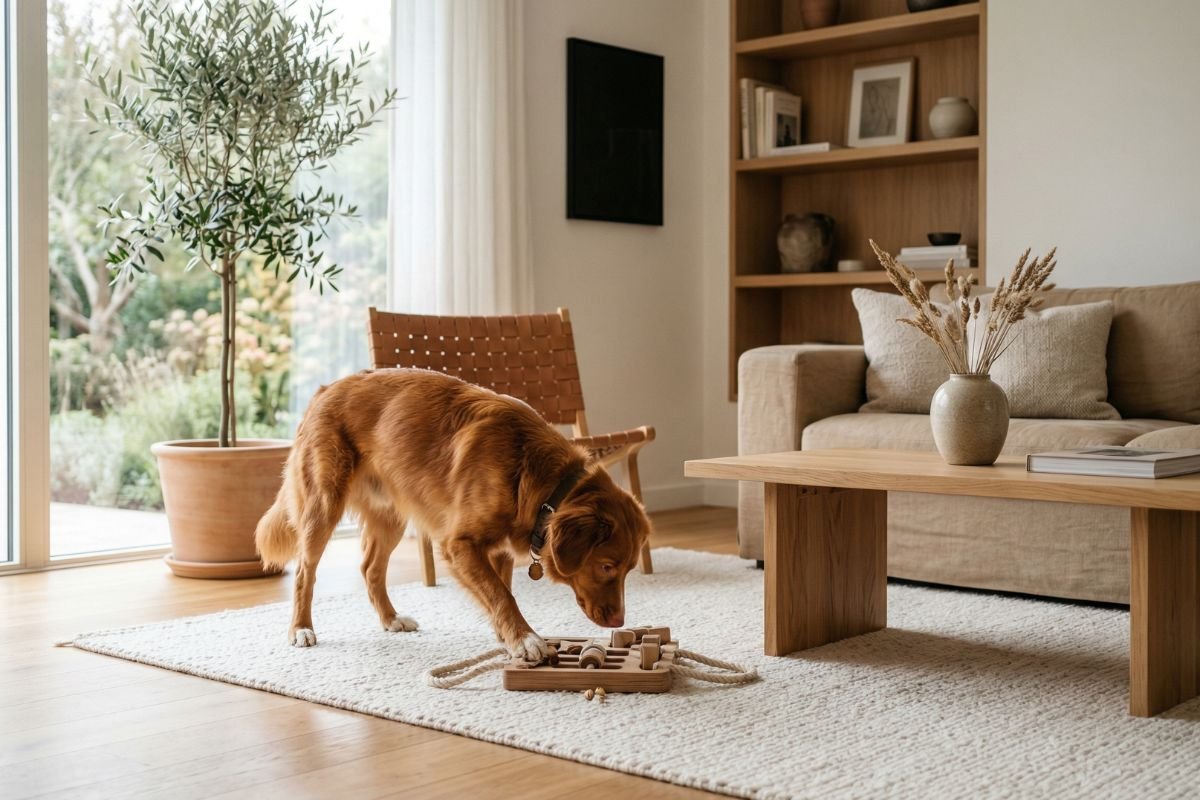
Using dog enrichment toys when your dog is home alone can make short absences calmer, more structured, and easier for your dog to understand. The right toy gives your dog something appropriate to lick, sniff, chew, or solve while you leave the house and they begin to settle.
An enrichment toy is not a full solution for separation anxiety or distress. It works best when your dog already has a predictable routine, a safe home setup, and a toy they understand before you leave. The goal is not to distract your dog from panic. The goal is to support a smoother transition from activity to rest.
Quick Take: What Helps Most Before You Leave
- Licking, sniffing, and safe chewing are usually the best enrichment styles for home-alone time.
- Simple toys often work better than difficult puzzles when your dog is already watching you leave.
- Size, material, and difficulty matter as much as the type of toy.
- The best results come from a full routine: walk, calm transition, enrichment, then rest.
Home-Alone Enrichment Guide: What Your Dog’s Reaction Means
| Situation | What it may mean | Best first step |
|---|---|---|
| Your dog uses the toy, then lies down | The setup fits the routine | Keep using that option for similar absences |
| Your dog finishes it fast and stays active | The toy is too short or too easy | Adjust texture, filling, or format |
| Your dog ignores it when you leave | The departure cue feels stronger than the toy | Practice with easier, lower-pressure moments |
| Your dog gets frustrated or rough | The difficulty may be too high | Make the toy easier and more predictable |
| Your dog pants, barks, scratches, or tries to escape | There may be real separation distress | Record the behavior and consider professional support |

Best Types of Enrichment Toys for Alone Time
Lick Mats
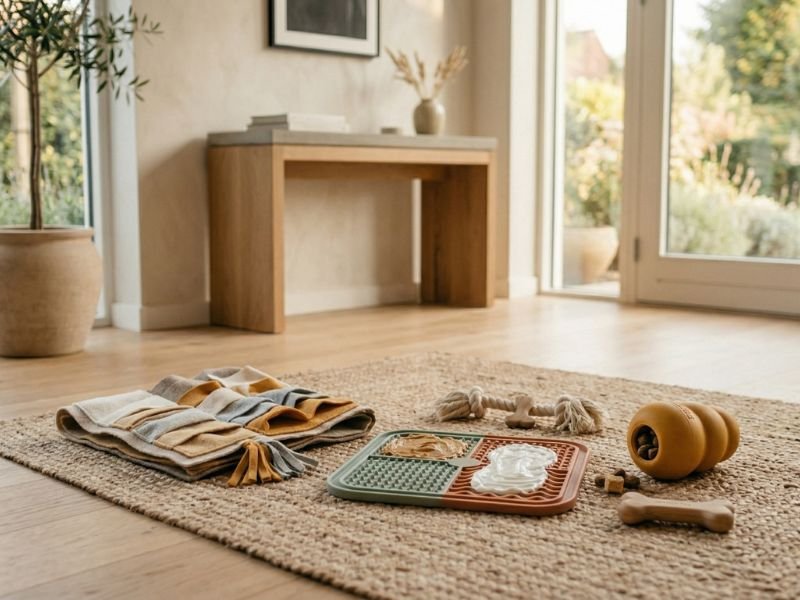
Lick mats are shallow textured surfaces where you can spread a small amount of dog-safe food, wet food, plain dog-safe yogurt, or another option that fits your dog’s diet.
They work well because licking is repetitive, slow, and easy to understand. For many dogs, that makes lick mats a good choice for short home-alone routines, especially when the dog already enjoys them with you nearby.
Choose a mat that stays stable on the floor and is easy to clean. If your dog chews silicone or tries to lift and destroy the mat, use it only with supervision.
Simple Stuffable Toys
Stuffable toys can be useful when your dog enjoys working food out of a safe rubber toy. Start with easy fillings before freezing or packing the toy tightly.
The best first setup is usually clear and rewarding. Your dog should understand how to use it without becoming tense or frustrated. If the toy is too hard, your dog may give up or chew aggressively instead of settling.
For dogs who already know the toy well, a lightly frozen filling can extend the activity. Keep the amount compatible with your dog’s daily food intake so enrichment stays healthy and sustainable.
Easy Scent Games
Sniffing can be excellent enrichment because it gives your dog a focused, natural activity. A simple snuffle mat or a few very easy hiding spots can work well before a short absence.
Keep the game accessible. Home-alone enrichment is not the moment for a complicated challenge. Your dog should be able to find the rewards easily and move into a calmer state afterward.
If your dog tears fabric, flips the mat, or tries to swallow pieces, choose a safer format.
Safe Chewing Options
Some dogs settle best through chewing. A safe chew or chew-friendly enrichment toy can help dogs who naturally use their mouth to relax.
This option needs the most care. Choose the right size, texture, and material for your dog’s bite style. Avoid anything that splinters, breaks into pieces, or becomes small enough to swallow. Check chews and toys regularly, and remove damaged items immediately.
For a deeper safety setup, connect this with your dog toy safety routine.
How to Use Dog Enrichment Toys When Your Dog Is Home Alone
1. Start With the Routine, Not the Toy
Offer the toy after your dog has had a chance to move, sniff, and release some energy. For many dogs, a short walk with plenty of sniffing is more helpful than intense physical exercise.
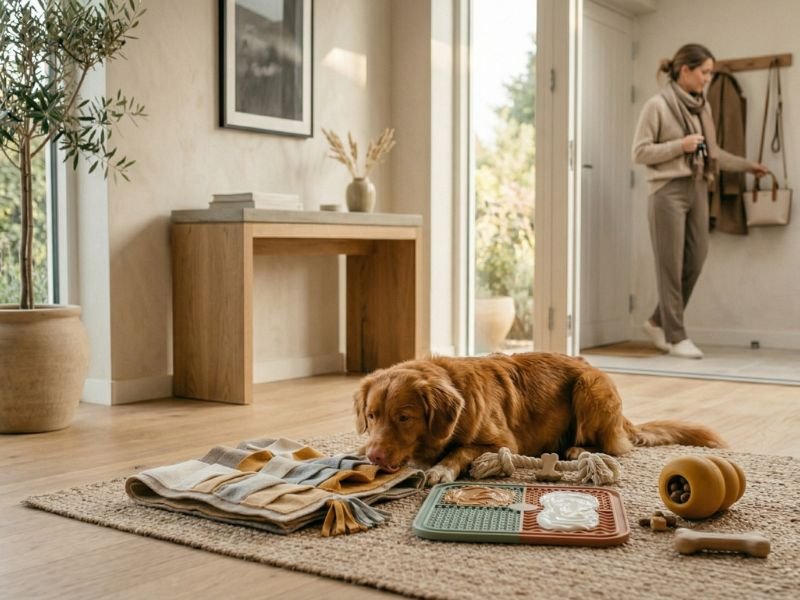
Then create a calm transition. Keep your exit simple, predictable, and low-drama. The toy should appear as part of the routine, not as a last-second distraction when your dog is already worried.
Start with absences your dog can realistically handle. A toy that works for 10 minutes may not work for a full workday.
2. Choose a Toy Your Dog Already Understands
Do not introduce a brand-new enrichment toy right before leaving. Test it first while you are home.
Watch how your dog uses it:
- Do they understand the task?
- Do they stay calm?
- Do they chew the toy safely?
- Do they finish and settle?
- Do they get frustrated?
For home-alone use, familiar and easy is usually better than new and impressive.

3. Adjust Difficulty and Duration
The right difficulty should keep your dog engaged without creating pressure.
If the toy is finished too quickly, try a slightly denser texture, a different filling, a frozen layer, or a format that lasts longer. If your dog abandons it, make it easier.
Avoid making the toy difficult just to extend time. A frustrated dog is not enriched; they are just working harder than they can comfortably manage.
4. Use One Main Option at a Time
Leaving several toys across the house can make the moment feel scattered. For many dogs, one well-chosen option is clearer.
Place the toy in a safe, familiar area where your dog already relaxes. Keep the environment simple: water available, hazards removed, and no access to toys or chews that require supervision.
A small rotation of two or three trusted enrichment formats is usually enough. This keeps the routine fresh without turning the home into an overwhelming toy station.
5. Observe What Actually Happens
A camera can be very useful, especially during the first few trials. You do not need to monitor everything forever, but the first minutes after you leave can tell you a lot.
Look for the real pattern:
- Does your dog use the toy calmly?
- Do they ignore it and follow the door?
- Do they finish it and rest?
- Do they bark, pace, pant, drool, scratch, or try to escape?
If you see clear distress, treat the situation as more than boredom. Enrichment may still support the routine, but the main plan needs to address the underlying discomfort.
BELPAW Check 🐾
Signs You Shouldn’t Ignore
- If your dog uses the toy but keeps staring at the door afterward, review the length of the absence and the routine before you leave.
- If your dog only rejects the toy when they realize you are leaving, the departure context is probably stronger than the enrichment.
- If you see panting, barking, drooling, scratching, pacing, or escape attempts, the issue may be separation-related distress rather than simple boredom.
Common Mistakes
- Choosing a toy that is too difficult because it looks more enriching.
- Leaving too many options at once and making the moment less clear.
- Using enrichment as a replacement for exercise, calm routines, safe setup, and gradual alone-time practice.
- Giving unsupervised access to a toy your dog has not already used safely.
Smart Tips
- Reserve a few enrichment options only for home-alone moments so they keep more value.
- Prioritize simple, stable, easy-to-use formats before complex puzzles.
- Use your dog’s daily food allowance wisely. Enrichment should support the routine without adding too many extra calories.
- Keep a short rotation: one lick option, one sniffing option, and one safe chewing or stuffable option can be enough for many homes.
FAQ
What type of enrichment toy is best when my dog is alone for a short time?
A simple lick mat, easy stuffable toy, or safe chew-style option often works well for short absences. Choose something your dog already understands and can use calmly.
Are complex puzzle toys better for home-alone time?
Not always. For alone time, easy and calming is often better than complicated. A difficult puzzle can create frustration if your dog is already sensitive to you leaving.
Can enrichment toys help with separation anxiety?
They may help as part of a broader plan, but they do not solve separation anxiety on their own. If your dog shows distress when left alone, focus on gradual alone-time training, a safer setup, and professional guidance when needed.
Final Thoughts
Dog enrichment toys can make home-alone time more structured, calmer, and easier for your dog when they are chosen with care.
Start with safe, familiar, simple formats. Build them into a routine that includes movement, sniffing, a calm transition, and a predictable resting space. Then watch what your dog actually does.
The best enrichment toy is not the one that looks most impressive. It is the one your dog can use safely, calmly, and consistently.
External References
- ASPCA — Separation Anxiety
- VCA Animal Hospitals — Behavior Management: Enrichment and Activity Toys
- American Kennel Club — Lick Mats for Dogs: Everything You Need to Know
- American Kennel Club — Everything You Need to Know About Snuffle Mats for Dogs
- Humane Society of the United States — Calm a Dog With Separation Anxiety Symptoms
Related Reads
- Best Elevated Dog Bowls for Dogs
- Best Orthopedic Dog Beds for Dogs
- Best Elevated Dog Beds
- Best Dog Beds for Large Dogs
- Best Dog Backpack Carriers for Small Dogs
- Portable Dog Water Bottle: What to Look For
- Best Portable Dog Water Bottles for Dogs
- 10 Best Dog Travel Accessories
- Dog Travel Accessories: Arrival Essentials
- Spring Dog Travel Essentials
- Best Interactive Dog Toys for Dogs
BELPAW Transparency
This article may include affiliate links. If you buy through them, BELPAW may earn a commission at no extra cost to you.